
Berries, branches and pods, the October stems that outlast the flowers
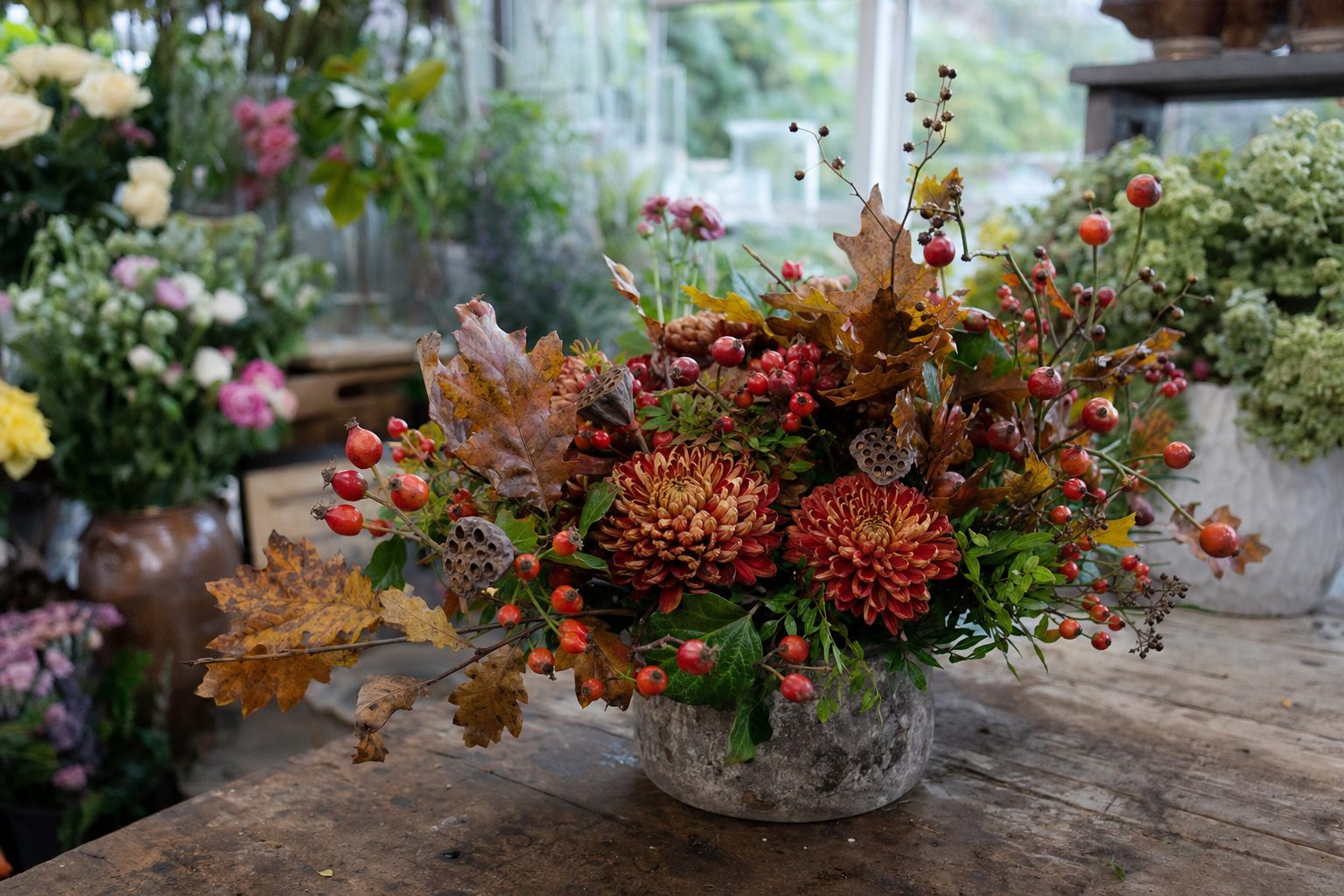
Walk into a flower shop in the middle of October and the flowers are only half the story. There will be mums, yes, and the last of the dahlias, and roses in colors that look like they were mixed in a cider press. But the thing that makes an arrangement read as autumn, the thing your eye lands on from across the room, is usually not a flower at all. It is a sprig of orange berries, a bare crabapple branch with three leaves clinging on, a lotus pod that looks like a shower head designed by a wizard. Florists call this material texture, or hard goods, or just "the good stuff in the back bucket." Most customers never ask for it by name. They should.
What is actually in the buckets this week
Mid-October is one of the richest moments of the whole florist year for non-flower material. Hypericum, the glossy berry that comes in brick red, coral, peach, cream and a slightly alarming chartreuse, is in full supply and will be through the holidays. Rose hips arrive in heavy, thorny branches that smell faintly of apples. Viburnum berries show up in metallic blue-black clusters. Pepperberry, which is the fruit of a pepper tree and not a food you want to grind over pasta, arrives in dusty pink cascades that look expensive because they are. Snowberry drapes in white or soft pink. Privet berry comes in sooty black sprays that make orange look twice as orange.
Alongside the berries sit the pods. Lotus pods, usually dried and imported, sometimes bleached. Nigella pods, striped like tiny beach balls. Scabiosa stellata, which is a perfect sphere of papery stars. Okra pods, poppy pods, milkweed pods, wheat, broom corn, millet, bunny tail grass. Then the branches: oak with the leaves still on, beech in copper, birch, winterberry once it colors up later in the season, magnolia with its suede brown undersides, curly willow for height.
Not all of this is in every shop. Berry and branch supply is regional and weather-dependent in a way that roses never are. A shop in Vermont may be cutting its own winterberry off a hedge behind the parking lot. A shop in Phoenix is buying everything on a truck. If you want to know what is plentiful and what is scarce in a given month, the florist's calendar of what is cheap and what is scarce is the honest version, the one designers actually plan around.
Why woody stems drink differently
A rose is a soft-stemmed thing with one job: pull water up a straw and hold a bloom open. A berried branch is a small tree. It has bark, dense tissue, and a much slower rate of uptake, which is why it behaves so differently on your kitchen counter. Woody stems take longer to start drinking, and once they do, they drink an enormous amount. A vase that held an all-rose arrangement for three days without needing a top-up will go bone dry in thirty-six hours with oak and hips in it.
Give them a clean, sharp, angled cut, and then leave them alone. Old advice says to smash the stem ends with a hammer to open them up. Modern practice has moved away from this, because a pulverized stem end sheds fiber into the water, feeds bacteria, and clouds the vase by day two. A longer angled cut with clean shears gives you the same increase in surface area without the mess. If you enjoy knowing which traditional tricks hold up under testing and which are folklore passed down through church flower committees, we worked through eighteen vase life tricks, tested, and the hammer does not come out looking great.
The other thing woody material wants is depth. Berries and branches do best in a vase filled two-thirds up, not the two inches of water that suits a tulip. Fill it high, check it daily, and if the water starts smelling like a pond, change it entirely rather than topping up over the top of it.
The berries that earn their keep
Hypericum is the workhorse and deserves its reputation. Two to three weeks of vase life is normal, and it often outlives everything around it, which is why thrifty people pull the hypericum out of a dying arrangement and start a second, smaller one in a juice glass. Rose hips last nearly as long and bring a wild, hedgerow quality that commercial flowers cannot fake. Both hold their color well.
Some berries are more temperamental. Viburnum drops. Snowberry bruises if you so much as look at it crossly, and the white varieties go translucent and slightly sad after about a week. Pepperberry shatters: it is effectively a dried product sold fresh-looking, and it will leave a fine pink confetti on your table for the rest of the month. None of that makes them bad choices. It means you should know what you are buying so you are not disappointed on day five. Ask at the counter which berry in the design is the short-lived one, and a good designer will tell you straight, then usually offer to tuck it where its collapse will not ruin the shape.
Branches do the architecture
Flowers fill space. Branches define it. One curved crabapple limb set high and to the left will do more for the look of an arrangement than six extra stems of spray rose, and in many towns it costs a fraction as much, especially if the shop cut it locally. This is the great quiet bargain of autumn floristry.
The catch with leafy branches is wilt. Oak and beech cut in October with the leaves still attached may droop within a day or two, because the leaves transpire faster than the woody stem can supply them. Shops get around this with glycerinated or preserved foliage, which has been treated so the leaves stay supple and colored for months, or by choosing branches that have already dropped most of their leaves and are being used for line rather than mass. Magnolia is the exception that behaves beautifully fresh, which is why you see it everywhere from October through Christmas. If you want leafy branches in a design that has to look good for a week, say so, and let the designer choose preserved material instead of fresh-cut.
A word about bittersweet
Every autumn someone asks for bittersweet, that twining vine with orange capsules that split to show scarlet berries. It is gorgeous, and it is complicated. The species most commonly sold is Oriental bittersweet, which is aggressively invasive across much of the eastern and midwestern United States, strangling trees and spreading through bird-dropped seed. Several states regulate or prohibit its sale and transport outright, and plenty of florists have quietly stopped carrying it regardless of what their state says.
If your shop does carry it, they will likely sell it dried, and they should tell you to bag the trimmings rather than toss them in the yard waste. If they say they do not stock it, that is not them being difficult. American bittersweet, the native cousin, is far less common in the trade and harder to source. Ask what they can offer instead, because the honest substitutes are good: rose hips, orange hypericum, crabapple branches, Chinese lantern, or dried orange slices wired onto picks.
Berries and the animals who live with you
A berry is a small, bright, chewable object at cat height. That is worth thinking about before you set a textural autumn arrangement on the coffee table of a household with a curious kitten or a labrador who eats drywall. Many ornamental berries are mildly to moderately irritating if eaten, causing stomach upset rather than disaster, but "mild" is a word that sounds very different at two in the morning. Pepperberry, privet and various ornamental nightshades all belong in the category of things not meant for chewing.
The practical move is to mention your pets when you order, not after. Florists field this question constantly and keep a mental list of safer builds. Our guide to which flowers are safe around cats and dogs sorts the usual suspects into risk tiers, and lilies remain the one true emergency for cats, berries or no berries. For an autumn design, a pet-conscious version leans on pods, grasses, preserved foliage and safe blooms, and skips the loose fruiting material entirely.
How to ask for texture without using florist words
You do not need vocabulary. You need a picture in words. "Something that looks like it came out of a hedgerow" works. So does "more woodsy than flowery," or "I want it to look like October, not like Valentine's Day in orange." If you want the arrangement to lean hard into texture, say: "Could you use more berries and pods and fewer flowers, same budget?" That sentence is a gift to a designer, because it gives them permission to build the thing they actually want to build.
Three more phrases that get good results. "What did you cut locally this week?" often surfaces material that never makes it onto a website. "Low and long, nothing above six inches" is how you get a dinner table centerpiece people can talk over. "Designer's choice, I trust you" remains the best value sentence in the business, and it is especially true in October, when the best material changes week to week and the website photos were shot in April. This is also exactly why a phone call beats a web form in autumn, a point we have made before and will keep making.
What the texture costs you
Berries and pods are not automatically cheap. Hypericum is sold by the bunch at wholesale and sits in the middle of the price range, while pepperberry and imported pods can be pricey per stem. What they give you back is duration and volume. A branch occupies space that would otherwise need six flowers, and berries hold their looks for two or three times as long as most blooms, which means an autumn arrangement often ages better than a summer one. You are trading a little flash for a lot of staying power.
In most of the country, a textural autumn arrangement from a real shop lands somewhere between 65 and 110 dollars depending on size, container and your town's cost of doing business. Under that, you are into smaller, charming, counter-sized work. Above it, you are buying scale and a heavier vessel. Prices for the identical design vary more by zip code than most people expect, which is a subject unto itself.
Care, by stem type
A single arrangement in October may contain four materials with four different needs. Here is the shorthand.
| Material | Expect | Care note |
|---|---|---|
| Hypericum, rose hips | 2 to 3 weeks | Deep water, recut if you rearrange. Outlives the flowers. |
| Viburnum, snowberry | 5 to 8 days | Drops and bruises. Keep away from heat vents. |
| Pepperberry | Indefinite, shattering | Essentially dried. Expect fallen berries on the table. |
| Leafy branches, fresh cut | 2 to 7 days | Leaves wilt first. Preserved foliage lasts months. |
| Pods, grasses, wheat | Months to years | Keep dry. Dust with a hairdryer on cool. |
The practical consequence of that table is that autumn arrangements should be edited, not discarded. Around day eight, pull the collapsed dahlias and the spent mums, lift what remains, recut it, and put it in a smaller vessel. You will usually get a second arrangement that lasts another ten days and looks deliberately spare, which is a very flattering look in November.
The second life of an October arrangement
Autumn is the one season where drying is not a sentimental compromise but a genuinely good outcome. Pods and grasses are already there. Hydrangea, if your arrangement has it, dries beautifully if you let the water in the vase evaporate rather than yanking the stems out and hanging them. Strawflower, statice, celosia and amaranth all hold shape and most of their color. Wheat and broom corn want nothing from you but a dry room.
What does not dry well: anything fleshy or high in water. Dahlias shrivel into brown knots, as anyone who has tried to preserve the last of the season's blooms has discovered, and the race against frost described in our piece on dahlias and the first frost ends with eating them visually and letting them go. Roses can be dried but go brittle and dark. Lilies are hopeless. If you want a keepsake rather than just a bowl of pods, the bouquet preservation timeline walks through what to do in the first hour, the first week and the first year, and the first-hour decisions matter more than anything you do later.
Thinking a month ahead to the table
Thanksgiving falls late this year, which gives everyone a long, generous November. It also means the berry and branch material you are admiring in mid-October is the same material your florist will be building holiday centerpieces from, and the best of it gets claimed early. Shops place their Thanksgiving orders weeks ahead and hold back the good branches for designs that are already on the books.
If you host, call your shop before the end of October and have one short conversation. Tell them the table dimensions, whether anyone sits on the ends, how long the meal runs and whether candles are involved. Ask for low and long. Ask whether they can build something that will still look good the following weekend, because with berries and pods in the mix, the answer is usually yes, and that changes the math on what you are willing to spend. A centerpiece that carries you from Thursday dinner through the next weekend of leftovers and visiting cousins is a different purchase from one that peaks at 6pm and sulks by Saturday.
None of this requires a special relationship or insider knowledge. It requires a phone number for an actual shop with actual buckets in the back, which is the whole reason we built the directory in the first place. Find the shop nearest the table, call during a weekday lull rather than Saturday morning, and say the words that open every good autumn order: show me what came in this week.