
Wreaths, garlands and the greens order you should place in November
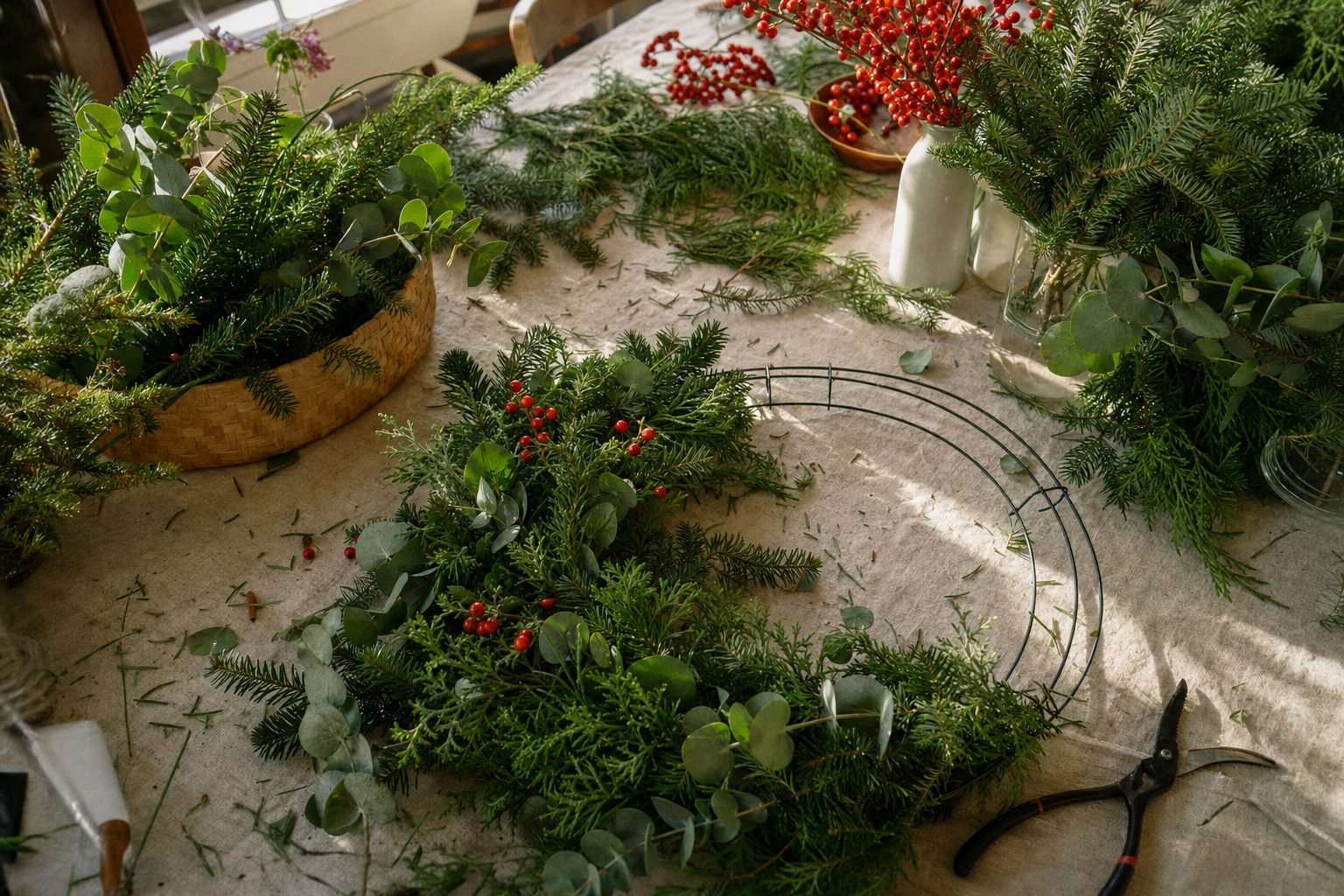
Walk into a flower shop this week and you will smell it before you see it. Somewhere behind the cooler, under a work table or stacked against the back door, there is a bundle of fir or cedar waiting to be turned into something. November is quiet out front and loud in the back. The holiday greens season is already underway, and most customers will not think about it for another three weeks, which is exactly the problem.
If you want a real wreath on your real door, made by somebody within driving distance of that door, the first week of November is a good week to pick up the phone. Here is what happens between now and December at a neighborhood shop, and how to order greens like somebody who knows the schedule.
Why greens get decided in autumn, not in December
Fresh evergreen is a harvested crop with a short window. Most of the noble fir, cedar, pine and boxwood that ends up in American flower shops is cut in late autumn, after the trees have hardened off for the cold, and then moved fast through wholesalers in big bundled boxes. Cutting too early gives you needles that drop in a warm living room. Cutting too late means fighting snow and frozen roads in the growing regions. So the harvest is compressed, and the quantity is roughly what it is.
Your florist places standing orders with wholesalers weeks ahead based on last year's numbers plus a guess. If they order 60 wreath bases and sell 60, they feel clever. If a customer calls on December 18 wanting four garlands for a stair rail, the honest answer may be that the cedar is gone, or that what remains costs considerably more than it did in November. Shops are not being precious about deadlines. They are telling you what is in the box.
The same logic shapes the rest of the floral year, which is why the florist's calendar of what is cheap and what is scarce is worth a skim before you order anything in a holiday month. Supply is seasonal even when the demand is not.
What actually arrives at the back door
Open a greens delivery in mid November and you get a smell that is hard to describe to anyone who has not stood in it. Here is what tends to be in there, and what each one is for.
Noble fir is the backbone. Stiff, blue-green, well-spaced needles, holds its shape, holds its needles, and makes the classic door wreath that people picture. Fraser fir smells sweeter and feels softer. Cedar, usually incense or western red, drapes. That drape is why garlands lean on it. Pine, especially white pine, brings long soft needles and a loose silhouette. Juniper adds blue berries and a slightly sharp, gin-adjacent scent. Boxwood is the tidy, formal one, dense and round, favored for topiary shapes and small table pieces.
Then come the accents, which is where a florist earns the money. Magnolia leaves with their brown suede backs. Eucalyptus, silver dollar or seeded, for the softer grey-green look that has taken over so many mantels. Winterberry branches, leafless and beaded with red, which are glorious and genuinely expensive because the crop is small and the birds get a vote. Pine cones, preserved oak, dried pods, cotton stems, berried ilex, and whatever the shop stockpiled during the autumn branch and pod season and saved for exactly this moment.
How long each green really lasts
Longevity depends more on where you hang it than on what it is made of. A wreath on a shaded north-facing door in Minnesota can look good for seven weeks. The same wreath on a sunny glass storm door in Phoenix is in trouble by week two, because the air between the storm door and the front door turns into a solar oven.
| Green | Outdoors, cold climate | Indoors, heated room |
|---|---|---|
| Noble or Fraser fir | 5 to 8 weeks | 2 to 3 weeks |
| Cedar | 4 to 6 weeks | 1 to 2 weeks, dries fast |
| Boxwood | 4 to 6 weeks | 2 to 3 weeks, may bronze |
| Magnolia leaf | Whole season | Whole season, dries handsomely |
| Fresh eucalyptus | 3 to 5 weeks | Dries in place, still pretty |
Nobody can promise you a date. Wind, sun, and whether your porch gets afternoon heat matter more than any guarantee. What a good florist will do is ask where the piece is going before they build it, and steer you toward magnolia and fir if the answer is "full sun until New Year's."
What a wreath costs, honestly
Price ranges vary by region and by how much hand work goes in, but the shape of it is consistent. A plain undecorated fir wreath, 20 to 24 inches, in the 30 to 55 dollar range at most shops. Add a weatherproof bow, cones and a few berry accents and you are typically at 60 to 110. Mixed greens with magnolia, eucalyptus and winterberry, built on a larger frame, runs 110 to 250 and upward, because winterberry alone can be a meaningful share of that number.
Garland is sold by the foot, often somewhere between 12 and 30 dollars per foot depending on how heavily it is decorated, and people consistently underestimate how many feet a staircase eats. Measure the rail, then add a third for the swag and the drape. A mantel usually wants the mantel's width plus 18 to 24 inches of tail on each side if you want it to look generous rather than apologetic.
Large wreaths get expensive faster than people expect, because the price curve is not linear. A 36 inch wreath is not 50 percent more work than a 24 inch wreath. It is roughly double the greens, a heavier frame, more wire, more structural thinking, and two people to hang it. If you have a commercial storefront or a tall entry, say so early.
Fresh, faux, or a sensible mixture
Plenty of florists now sell both, and there is no shame in either. Fresh greens smell like the thing they are, which is most of the point, and they cost what they cost every single year. Permanent botanicals cost more up front and then cost nothing for five seasons, which makes them sensible for a second-floor window nobody can reach or a doorway that bakes in the sun.
The common compromise is a faux base with fresh accents wired in. You keep the frame, bring it back in November, and the shop refreshes it with new fir tips, fresh berries and a new ribbon for a fraction of the full price. Ask whether your shop offers that service. Many do and few advertise it, because refreshing wreaths is tedious work that happens in the same three weeks as everything else.
On ribbon: outdoor bows should be weatherproof polyester or waxed cotton, not paper-backed velvet, unless you enjoy watching a bow turn into a damp sock after the first rain. A florist who asks "indoor or outdoor?" before choosing ribbon is a florist paying attention.
Matching the piece to the place
A door wreath has to survive being slammed. That means a wired frame, not a glued one, and accents attached with wire rather than hot glue wherever possible. Glue fails in cold. Wire does not.
Mantel garland needs to account for heat and for candles, which is a conversation worth having out loud. Dried eucalyptus and a lit candle are a bad pairing. Many shops will build a mantel piece with a water source hidden in it, or recommend a centerpiece-style runner in foam that you can top up every few days instead of a dry garland that crisps in a week.
Table centerpieces for winter entertaining follow the same rules as any dinner arrangement. Low enough to see across, not too fragrant if food is involved, and built on something that will not sweat onto the wood. If your table hosts a long, slow meal with people lingering, a compact arrangement of fir, roses and berries will do more work than a tall showpiece that everyone leans around.
Porch pots are the underrated winter purchase. Florists in cold regions build them in autumn containers using fir, cedar, birch branches, dogwood twigs and cones, and they sit outside looking composed from late November until the crocuses show up. In a climate where nothing blooms for four months, a pair of porch pots is the best dollar-per-day decoration a shop sells.
The dates that actually matter on the shop calendar
Here is the rhythm in most American flower shops between now and the end of the year. First two weeks of November: greens orders placed with wholesalers, wreath frames and ribbon stocked, holiday consultations booked with commercial clients. Mid November: first greens deliveries arrive, wreath production begins in the back during slow retail hours. Week of Thanksgiving: the shop is simultaneously doing centerpieces, hosting walk-ins, and trying to build a hundred wreaths. That week is the tightest of the season, tighter than the week before Christmas in a lot of towns.
Thanksgiving weekend through the first week of December: pickup and delivery of wreaths and garlands, residential and commercial decorating installs, the first wave of corporate gift orders. Second and third weeks of December: gift arrangements, office parties, and the arrival of the people who assumed there would be plenty of cedar left. Christmas Eve: deliveries end early, usually by midday, and the shop closes with everyone slightly feral.
Booking a wreath for pickup on a specific date in November or early December puts you in the calm part of that schedule. If you want to see how the whole week fits together behind the counter, how a neighborhood flower shop plans its week explains the usual rhythm, and the holiday version is that rhythm with the volume knob broken off.
What to tell the florist when you call
The phone is still the best tool for this, because greens orders involve measurements, exposure, and judgment calls that a website checkout form cannot handle. There is a longer argument for that in why calling a flower shop beats its website, and holiday greens are the clearest example of it.
- The diameter you want, or the measurement of the door if you do not know. A 24 inch wreath suits most standard front doors. Double doors and tall entries want bigger.
- Whether it hangs outside, inside, or behind a glass storm door. That one answer changes the build.
- Your color, including the color of the door itself. Red berries vanish against a red door.
- Scent tolerance, especially for indoor pieces in small apartments or offices with sensitive staff.
- Candles, yes or no, for anything going on a mantel or table.
- Your pickup or delivery date, and whether you need it hung.
- Your budget, said plainly. A florist given a real number will build to it rather than guessing low and disappointing you.
Ask two more questions while you have them. Do they offer a hanging service, and do they take the piece back at the end of the season for composting? Plenty of shops do both, and the second one is a genuine kindness in January when you are staring at a dried wreath and a trash can that does not fit it.
Keeping greens alive longer than they want to be
Fresh-cut evergreen does not drink much once it is wired to a frame, so most of the game is slowing evaporation. If your wreath lives outdoors in the cold, you have already won most of it. Cold air, low light and no central heating are ideal conditions.
Indoors, mist pieces every couple of days with plain water, and keep them away from heat vents, radiators, wood stoves and the top of a television. An antidesiccant spray, the kind sold for Christmas trees, helps a garland hold its needles through a warm house. Some people soak a new wreath overnight in a bathtub of cool water before hanging it, which does help, though it also soaks a ribbon that was not designed for swimming, so remove the bow first.
Fresh roses or amaryllis tucked into a holiday arrangement follow normal rules, not greens rules, and they are the part that fades first. Cold delivery conditions affect them too, which is covered in what the first freeze does to a flower delivery. Short version for your porch: do not leave a box of fresh flowers sitting outside in December while you are at work.
Greens without the Christmas of it all
Not every winter doorway is celebrating the same thing, and good florists build for that without being asked twice. Winter greens with white tapers and silver accents work beautifully for Hanukkah tables, which fall in December this coming season, and a mixed arrangement of white roses, paperwhites and fir reads as winter rather than specifically Christmas.
Solstice pieces lean toward birch, dried seedheads, moss and candles. New Year arrangements go metallic, white and structural. A hostess gift for a December dinner party can be a small boxwood topiary or a bowl of amaryllis bulbs rather than anything with a bow. If you want a piece that says "winter, warmth, welcome" and nothing else, say that to your florist in exactly those words. They have built it before.
Why the shop near the door matters here
Greens are heavy, bulky, and frankly miserable to ship. A wreath shipped across the country arrives compressed in a box, having spent three days in a dark truck, and it needs fluffing and a day to recover if it recovers at all. A wreath made nine miles from your house arrives in the back of somebody's car, upright, smelling like a forest, built by a person who asked what color your door was.
The price difference is often smaller than people assume once shipping is accounted for, and the local version comes with the option of calling back and saying the bow is too small. Try that with a fulfillment center. If you do not have a shop in mind yet, the directory lists real storefronts by town with their phone numbers and delivery areas, which is all you need to make one call and get a date on the calendar.
Do it this week if you can. Sometime around November 20 the back room of every flower shop in your town turns into a wreath factory, and the person answering the phone will be holding pruners in their other hand, standing in a pile of fir, trying to be nice to you. They will be nicer if your order is already written down.